Case study in progress
Service DesignDesign LeadPrototypingPublic Sector2023

From user insight to more effective period closing across government agencies

A two-month service design project for DFØ, the Norwegian Agency for Public and Financial Management — from open brief to a concept DFØ implemented the following year.
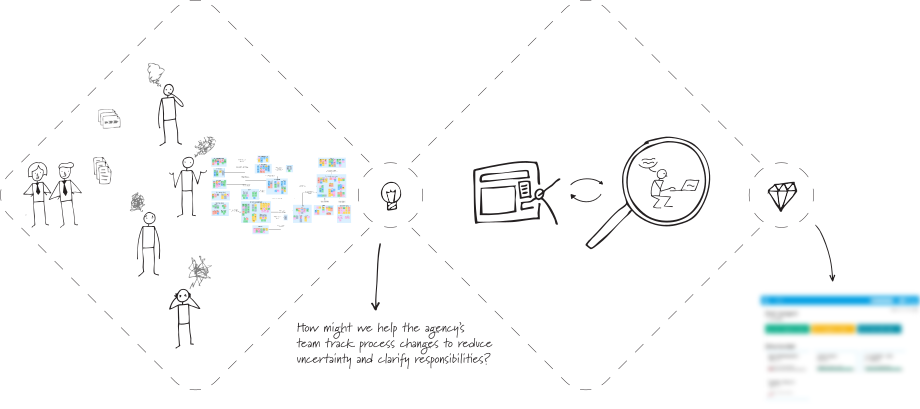
Hand-drawn double diamond process: frustrated users and research artifacts in the first diamond, a lightbulb with the how-might-we question at the pivot, prototyping and user-testing loops in the second diamond, ending in a gem pointing to the final product
The project's double diamond — two months from open brief to validated concept

Every month, DFØ closes the accounting period for ministries and state agencies across Norway — a deadline-driven collaboration between DFØ's accountants and controllers and their customers' finance teams. The process strained both sides. I led a team of three consultants through a full service design cycle: understanding how period closing really works, locating where the collaboration breaks down, and prototyping a digital concept to fix it. DFØ used the concept to develop and implement the solution in 2024.

Role
Project Lead, UX Designer (Deloitte)
Team
Three consultants; steering group of department directors
Duration
2 months (Jun–Aug 2023)
Impact
Concept developed and implemented by DFØ in 2024
Responsibilities
Method, planning and delivery · research · facilitation · process flows, UX and prototyping · reporting to the steering group

Problem area

A monthly process held together by Excel, e-mail, and verbal agreements

DFØ provides financial and accounting services to state organizations — ministries, departments, and agencies. Monthly period closing is the most intense touchpoint: a complex sequence of manual tasks spread across spreadsheets, e-mail, and four different systems, performed under deadline pressure by people on both sides of the service.

DFØ wanted insight into how government agencies actually carry out period closing — and to explore digital solutions that could strengthen collaboration, efficiency, and service quality. The brief was deliberately open: no predefined problem, no predefined solution.


Design goals

What I aimed to achieve

Understand the real process
Map how period closing actually runs across agencies — beyond what the routine descriptions claim.
Find where collaboration breaks
Locate the friction between DFØ's accountants and controllers and their customers' finance teams.
Deliver a concept worth building
Hand over a validated, user-tested prototype with a realistic technology path — not a report that ends up in a drawer.

Research approach

Two layers of interviews, one clear focus

We started wide: stakeholder interviews with domain experts and DFØ's leadership to map the whole service landscape. That led to a deliberate scoping decision — the monthly closing process stood out for its complexity and the friction in customer interactions, so we made it the focus.

Then we went deep: 10 in-depth interviews — five with DFØ controllers and mid-level managers, five with members of customers' finance teams — alongside a study of process and routine descriptions. I synthesized the material with affinity mapping, archetypes, and process maps.

The research surfaced a service that was fragile by design and demanding for both sides:

Fragile by design
Each customer's process was customized — often through a verbal agreement between two individuals. When people changed jobs, the agreement walked out the door with them.
Demanding for both sides
Unclear roles, hard-to-find process information, and uneven accounting skills led to delays, time pressure, and high stress for DFØ employees and customers alike.
Roles were open to interpretation
High-level role descriptions left room for interpretation, producing process variations and a widening gap between expectations and reality.
Knowledge lived in people, not systems
Process information was hard to find, and customizations existed as verbal agreements between individuals — staff turnover regularly erased them.
Skills varied wildly
Customers' accounting experience differed greatly, and the process punished those with less of it — for them, every closing was harder and more stressful.
The tools didn't collaborate
Many manual tasks across fragmented systems with poor collaborative functionality created inefficiency, delays, and stress on both sides.
How might we
…help the agency's team track process changes to reduce uncertainty and clarify responsibilities?

Concept development

A user journey first, screens later

Before any interface work, we defined a simple user journey as the backbone of the concept. Through co-creative sessions, the team shaped a digital tool around it — making sure technical and regulatory perspectives were built in from the start, not patched on at the end.

Log in
Choose process
Check tasks and statuses
Choose task to perform
Perform task
Leave comment if needed
Customize process
Scroll horizontally to explore the journey →
Performed in the tool
Performed outside the tool
Available to DFØ employees only
The user journey that anchored the concept

The concept gave the journey substance — a tool that would:

Show the customized process
One shared view of the tasks that must be completed — by DFØ and by the customer.
Explain every task on demand
Detailed descriptions of each manual task and how to complete it, available when needed.
Make progress visible across teams
Task completion visualized for both sides — transparency that manages expectations.
Keep customizations documented
Process changes tracked in the tool instead of in someone's memory.

The pivot

Killing our own concept before the client had to

Presenting the concept to Deloitte's domain experts exposed a flaw we couldn't ignore: manually tracking tasks in yet another tool would itself become a burden. Instead of defending the design, we used the critique to sharpen it — refining the idea into a digital process orchestration tool, a “digital brain” that integrates with enterprise systems, automatically guides users to the tasks that need their attention, and visualizes manual and automated work in one place.
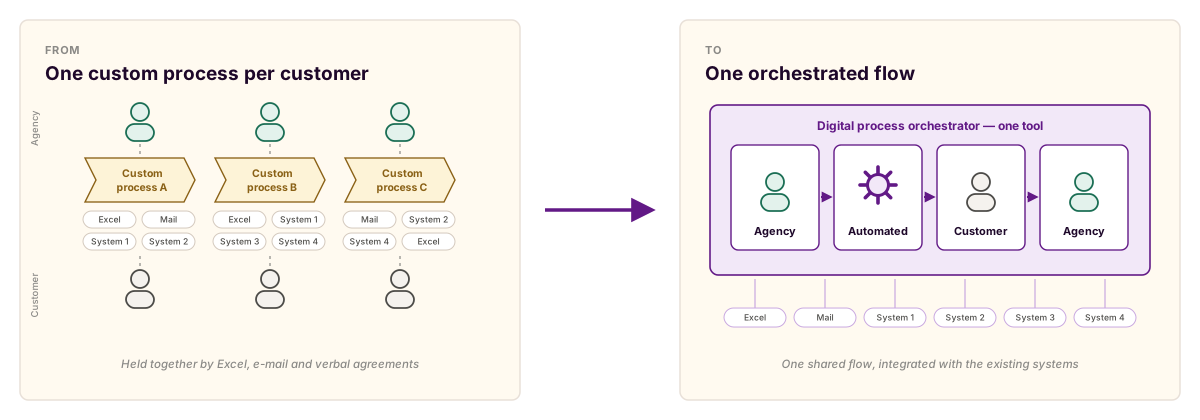
From fragmented, customer-by-customer processes to one orchestrated flow
Feedback over attachment
The concept improved because we treated expert critique as material, not as a threat to the design.
Same insight, stronger mechanism
The user need didn't change — the burden of acting on it moved from the user to the system.

Prototyping & feasibility

Paper first, pixels second, technology last

We kept fidelity as low as the questions allowed. A paper prototype explored the digital components and interactions; FigJam flows stretched the concept further; a clickable Figma prototype then carried the user testing, where each round refined features and validated usability.
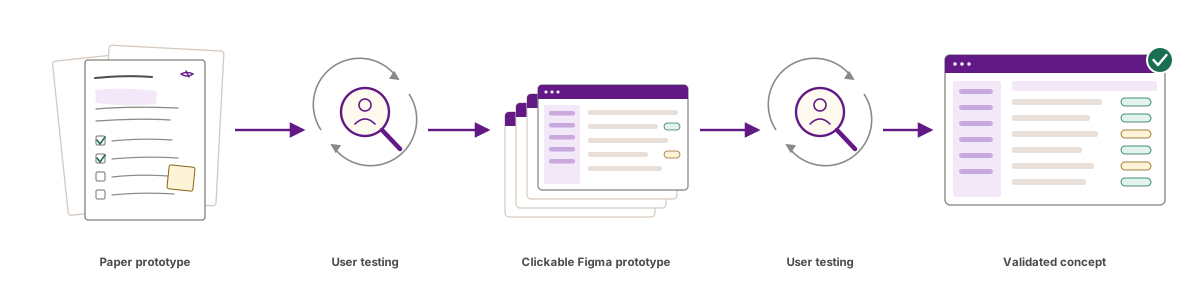
From paper prototype to clickable Figma prototype — tested and refined round by round

To make the concept actionable rather than aspirational, we evaluated orchestration technologies — including Pega Systems and Power Apps — for integrating the tool with customer applications. The final delivery paired the validated prototype with a comprehensive insight analysis and a concrete technology recommendation.


Retrospective

A concept DFØ chose to build

The prototype demonstrated how the tool could visualize the monthly closing process, document manual and automated tasks, and guide users in real time. The work didn't end as a slide deck: DFØ used the concept to develop and implement the solution in 2024.

Implemented in 2024
DFØ used the concept to develop and roll out the solution the year after the project.
2 months, brief to concept
A full double diamond — research, definition, co-creation, prototyping, and testing — in eight weeks.
10 interviews, both sides
DFØ controllers and managers plus customer finance teams — the full service relationship, not just one half.
Anchored at director level
I reported to and facilitated a steering group of department directors throughout.

What I learned

Fidelity is a tool, not a goal
Low-fidelity prototypes delivered the most feedback per hour. High fidelity was useful for complex interactions — but could have waited even longer.
Deliverables should fit the ambition
Not every project needs exhaustive design artifacts. Scope and ambition should dictate the level of detail.
Ambiguity rewards iteration
Leading a project with an undefined problem space taught me to prioritize flexible methods and fast learning loops over rigid plans.
← Back to portfolio

Other projects

Continue exploring

Turning Nav's struggling budget tool into “a dream tool” for 300 users
A 20% rise in user satisfaction at the Norwegian Labour and Welfare Administration.
Using service design to improve mental health services through the eyes of healthcare specialists
An advisory engagement with Helse Sør-Øst: from clinician insight to a co-created improvement roadmap.