Exploring how AI and flipped classroom models can personalize higher education.
When one-on-one tutoring beats 98% of lectures, why are lectures still the default?
Four reasons the dominant teaching format struggles.
Surface coverage, shallow learning
Lectures cover surface but rarely go deep. Active learning and structured self-study consistently produce stronger outcomes for the same time invested.
Passive listening, drifting attention
Reduced attention, dropping attendance, especially when lectures don't engage students actively. The format works against how the brain learns.
No clear value beyond the textbook
When students can't see what a lecture gives them beyond reading alone, motivation falls. Feedback is rare; the relationship to the teacher and the material weakens.
Strategic learning, short shelf life
Combined with exam formats that reward memorization, lectures often produce strategic, short-term learning instead of lasting understanding.
Two parts of one system.
Flipped classroom
Theory moves out of the lecture hall and into self-study. Class time is freed up for practice, problem-solving, and collaboration. The things students actually need a teacher and peers for.
Pitfall on its own: without good preparation materials, students arrive unprepared and frustrated.
AI tutor
A personalized companion for self-study. Adapts to each student's background, learning preferences, and pace. Gives feedback in real time and flags students who get stuck.
Pitfall on its own: too much screen time, too little human interaction.
Neither AI tutoring nor the flipped classroom is innovative on its own. Together, they handle each other's blind spots: the AI does the patient, individualized work that doesn't scale for a teacher; the classroom keeps the social, practical, human side of learning intact.
How it actually works, end to end.
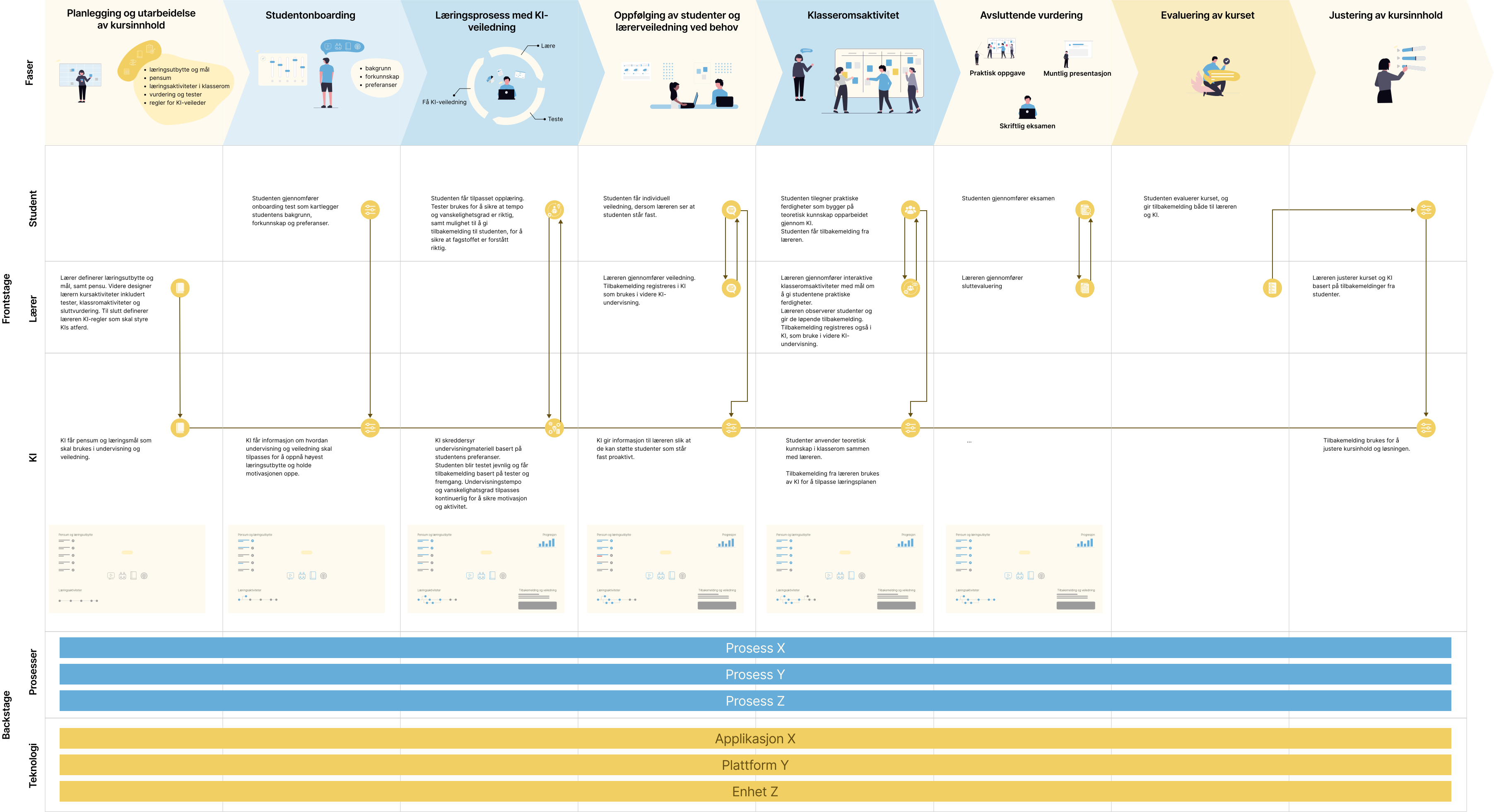
The full course flow runs across eight phases from the teacher planning the curriculum, through student onboarding (where the AI maps background, prior knowledge, and learning preferences), through AI-guided self-study with continuous check-ins, into classroom activities and final assessment. The teacher remains the pedagogical owner. The AI handles personalization at scale.
Mapping student needs to design choices.
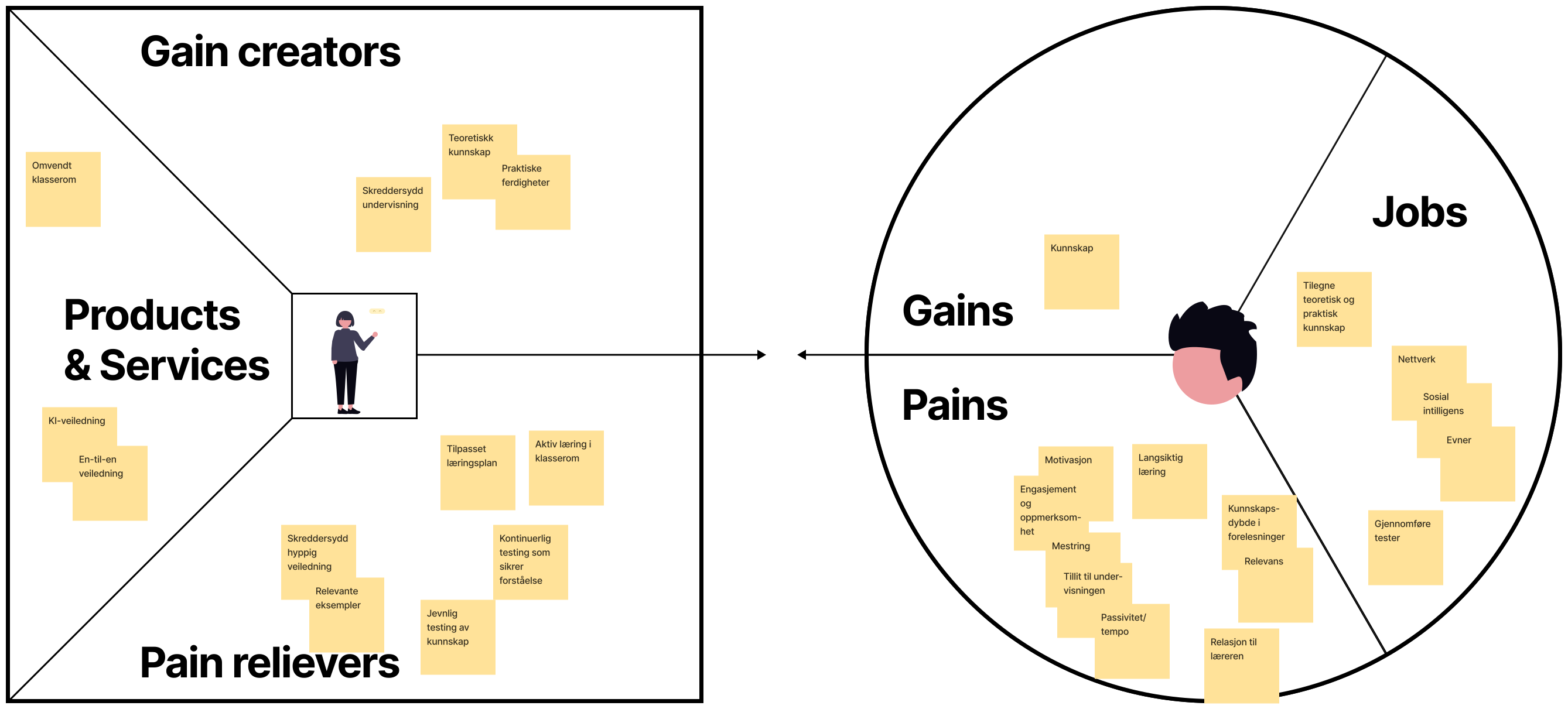
Every part of the concept traces back to a specific student pain or opportunity. The canvas above maps it: students' jobs, pains, and gains on the right; the corresponding pain relievers and gain creators on the left.
A concept like this doesn't land in one place.
A speculative design that ignores how it ripples through the system isn't useful. Every domain below carries both an opportunity and a risk worth taking seriously.
Economic
Frees teacher capacity from lectures and grading toward proactive coaching.
High licensing and operating costs may exclude smaller institutions and create new inequalities.
Social
Democratizes access to high-quality, personalized tutoring.
If classroom attendance declines, students may graduate with strong theory but weak collaboration skills.
Environmental
Less commuting and less physical infrastructure for pure lectures.
AI inference is energy-intensive. Every interaction has a carbon cost.
Ethical
Earlier, more honest feedback for students who would otherwise fall through the cracks.
Personalization needs data. Privacy, GDPR, and AI hallucinations all become first-order concerns.
Organizational
Teachers shift from lecturers to facilitators and curators, a more strategic role.
Without training, time, and cultural support, the change feels like a threat instead of a tool.
Responsible design, not technological inevitability.
A speculative design isn't useful if it pretends nothing can go wrong. Three principles would shape this concept's implementation.
Human in the loop
The teacher stays accountable for learning outcomes. Dashboards expose where students get stuck and where the AI drifts. Both can intervene.
Guardrails on content
The AI is constrained to a curated curriculum through RAG. When asked something outside its source material, it answers "I don't know" instead of generating.
Accessibility by default
Universal design isn't an afterthought. Readable language, screen-reader support, low-threshold interfaces, built in from the start, per Norwegian regulations.
Where the idea comes from.
Norwegian students spend around 33 hours a week on their studies, and the lecture remains the most widespread form of teaching (Studiebarometeret, NOKUT). The research has been clear for forty years: lectures are one of the least effective ways to actually learn. Bloom's 1984 study showed that students with personal tutors outperformed 98% of their peers in lecture-based classrooms.
The constraint is not the method, it's capacity. There simply aren't enough teachers.
In this project I explored how a personal AI tutor, combined with the flipped classroom model, could meet students' diverse learning needs. It builds on Bloom's 1984 finding that one-on-one tutoring outperforms traditional lectures for 98% of students, and asks what we'd actually design if AI loosened the capacity constraint that has kept tutoring out of reach.
What kind of education do we want?
The technology behind this concept already exists in fragments. Some students are already opting out of universities entirely and building their own AI-led curricula. The interesting question isn't whether something like this will arrive. It's what kind of institutions, regulations, and culture we want to put around it before it does.
What talent, infrastructure, laws, and norms must we put in place today if we want to acheive this the future (or avoid it)?